Disinfection below freezing
Why a winter treatment can be performed faultlessly and still deliver nothing, what exactly breaks in the cold, four workable strategies, and a winter checklist.

Winter is the only period in which disinfection can be performed formally faultlessly and still deliver nothing. Every step is in place: the building is washed, the product is right, the dilution is per the label, the log is filled in. And the microbial count after treatment is the same as before it.
The reason is that disinfection is a chemical reaction, and the rate of a chemical reaction depends on temperature. The rule of thumb: 10 degrees lower means roughly twice as long. A product that needs 15 minutes at 20 degrees needs over an hour at zero, and if it is not given that hour, there was effectively no treatment.
What exactly breaks in the cold
| Factor | What happens | Consequence |
|---|---|---|
| Reaction rate | Roughly halves per 10 degrees | Standard contact time becomes inadequate |
| Freezing of the solution | The film turns to ice | The active never physically contacts the microbe |
| Solution viscosity | Increases | Poorer wetting, poorer penetration into pores |
| Evaporation | Almost stops | The surface stays wet, then freezes |
| Stability of some actives | Changes | Certain products separate or lose activity |
| Gas treatment | The active does not distribute | Result close to zero below 15 degrees |
Four workable strategies
There are not many options, and they are not mutually exclusive - they are often combined on one site.
- Heat the building before treatment. The soundest route if you have heat available. The target is surface temperature, not air temperature: at least 10 to 12 degrees, and 20 to 24 for a gas treatment. Heating surfaces is the point: air warms in an hour, a concrete wall takes a day.
- Extend the contact time. A free tool. If the surface is at 5 to 10 degrees, increase exposure two to four-fold against the 20-degree label figure, and do not rinse early.
- Antifreeze component. Only where the specific product label permits it, and only within the stated limits. Adding salt or alcohol on your own initiative can inactivate the active or make the solution corrosive.
- Change the method. Where wet disinfection is impossible, switch to powder disinfection or to a gas treatment after heating. For footbaths that is usually the only real answer.
Which product for the cold season
There is no universal answer, but there are patterns by class. A detailed comparison of classes is in our piece on disinfectant classes.
| Class | Behaviour in the cold | Note |
|---|---|---|
| Peroxygens (KMPS) | Activity falls with temperature, but predictably | A workable choice with extended exposure |
| Aldehydes | Strongly temperature-dependent | Below 10 degrees efficacy drops sharply |
| QACs | Moderate dependence | Weak on non-enveloped viruses regardless of temperature |
| Phenolics | Relatively cold-tolerant | One of the practical options for vehicles |
| Alkalis | Work in the cold too | Corrosivity and operator safety requirements |
| Chlorine-based | Lose activity quickly | Plus dependence on pH and organic load |
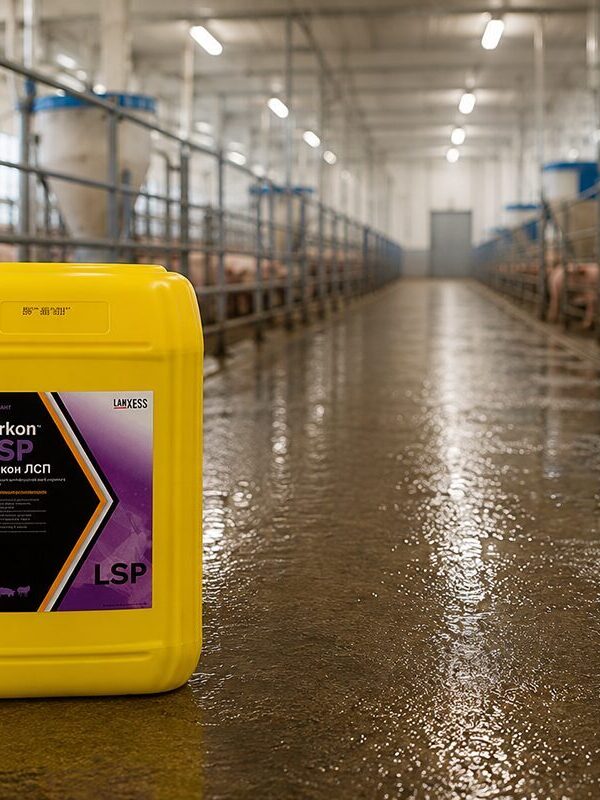
In practice, for outdoor work and vehicles Virkon LSP or Mevisan are common choices; for buildings after heating, Virkon S or Mevipou. Either way the low-temperature regime comes from the label of that product, never by analogy with another.
Washing before disinfection in winter
Washing in frost is a problem of its own and is usually underestimated. Cold water dissolves fat poorly, alkaline products work more slowly, and water left in crevices freezes and expands, damaging the fabric of the building.
- Warm water is not optional. Removing protein and fat soil needs at least 40 to 50 degrees; cold water merely smears the fat around.
- Foam application buys contact time, which matters especially in winter: foam clings to vertical surfaces instead of running off.
- Drain water completely before frost. Residues in trays, hoses, pumps and low points of lines will split equipment when they freeze.
- Drying between washing and disinfection takes much longer in winter, and the schedule has to allow for it.
On product choice and regimes see our piece on alkaline and acidic farm cleaners, and on why this step cannot be skipped, our piece on cleaning before disinfection.
Footbaths and mats in winter
This is the most common point at which winter biosecurity becomes decoration. A frozen tray looks like a footbath, is ticked off in the log as a footbath, and does nothing. Worse, it is harmful: staff get used to the barrier being there and stop thinking about the real risk.
The workable options: move the barrier into the heated changing room; heat the tray; switch to dry powder disinfection, which works below zero; or use an antifreeze solution the label permits. On why barriers fail even in warm weather, see our piece on disinfection barriers and foot dips.
What winter wins you
In fairness, the cold works for you too. Flies and most insects do not breed in winter, so insect control is barely needed and that frees up resource. Air humidity is lower, which removes part of the microbial load.
But two things run the other way. Rodents move into buildings from the fields precisely in winter, so rodent control needs more attention in the cold, not less. And ventilation is cut back, so ammonia and dust accumulate - covered in our piece on air quality on the farm.
Planning: what to move out of winter entirely
The cheapest winter solution is not doing in winter what can be done at another time. An annual sanitation schedule built around temperature saves more than any choice of product.
- Major sanitation of empty buildings with a full wash and gas treatment is planned for the warm season where the production cycle allows.
- Repairs to surfaces, gaps, gates and drainage also belong in warm weather, because those defects are what create most winter condensation and freezing problems.
- Leave for winter what does not depend on temperature: rodent control, feed management, staff training, document audits, equipment checks and calibration.
- Necessarily winter work means vehicle treatment and footbaths, because deliveries and movement do not stop; prepare a separate solution for them in advance, not on the first frost.
Typical winter mistakes
- The same contact time as in summer. The most common error; formally everything was done, in fact there was no treatment.
- Raising the concentration instead of the time. More expensive, more corrosive, off-label, and it barely helps.
- Heating the air instead of the surfaces. Air warms in an hour, concrete in a day; the solution works on the surface.
- Gas treatment in a cold building. Below 15 degrees the result is close to zero at full product consumption.
- A frozen footbath logged as completed. Worse than no barrier, because it creates the illusion of protection.
- Water left in equipment. It splits pumps, hoses and lines at the first serious frost.
- No temperature recorded in the log. It makes analysis impossible when the result is worse than expected.
A winter checklist
| Step | What to check |
|---|---|
| Before treatment | Surface temperature, not air; heating available; the forecast 24 hours ahead |
| Washing | Water at 40 to 50 degrees; foam application; all residual water drained |
| Drying | Actual dryness, not the schedule |
| Disinfection | The low-temperature regime from the label; extended contact time; actual temperature recorded in the log |
| Gas treatment | Heated to 20 to 24 degrees and 70 to 80% humidity before ignition |
| Footbaths | Heated, dry disinfection, or moved into a heated room |
| Vehicles | Heated bay, or powder treatment of wheels and arches |
| Equipment | Water drained from pumps, hoses, trays and low points |
| Verification | Swabs or ATP after treatment, because the result is not visible |
One line in that list deserves separate attention: recording the actual temperature in the treatment log. Without it, two months later you cannot work out why January swabs are worse than October ones at the same product and the same dilution.
Frequently asked questions
Can you disinfect below freezing?
You can, but not with an ordinary aqueous solution. The water freezes and the film of solution turns to ice instead of working, so the active never physically contacts the microorganism. The options below zero are: heat the building before treatment, add an antifreeze component where the product label allows it, use a gas treatment, or move wet disinfection to the warm season.
How does temperature affect disinfectant efficacy?
The rule of thumb is approximate but workable: a 10-degree drop roughly halves the rate of the chemical reaction. So a product that needs 15 minutes at 20 degrees needs 30 minutes at 10 degrees and over an hour at zero. The main winter tool is therefore contact time, not concentration.
Is it right to raise the concentration instead of the time?
Usually no. Going above the label concentration increases corrosivity, cost and operator risk, while delivering far less benefit at low temperature than extending the exposure. It also breaches the product label. The correct route is to warm the surface or lengthen the contact time.
What do you do about a footbath in winter?
An aqueous solution in the tray freezes and becomes decoration. The workable options: switch to a dry powder disinfectant, heat the tray, use a brine antifreeze solution within the limits the label allows, or move the barrier into the heated changing room. A frozen footbath is worse than none, because it creates the illusion of protection.
What is the minimum temperature for a gas treatment?
Smoke generators and gas disinfection need at least 20 to 24 degrees and 70 to 80% humidity. At 10 to 12 degrees the result is close to zero even at the full application rate, because the active distributes poorly and does not reach microcracks. Gas treatment in winter is possible, but only after heating the building.
Can vehicles be treated in frost?
Not properly by wet disinfection - the solution freezes on the bodywork. The practical answers: wash and disinfect in a heated bay, use products with a permitted antifreeze component, or switch to powder disinfection of wheels and arches. Vehicle treatment is a critical control point, so you change the method rather than drop it for the winter.