Brodifacoum: potency, timing and secondary poisoning
How brodifacoum works, why the rodent dies in 3 to 10 days, how it differs from the other anticoagulants, when it is genuinely needed, and three rules that remove most of the risk.
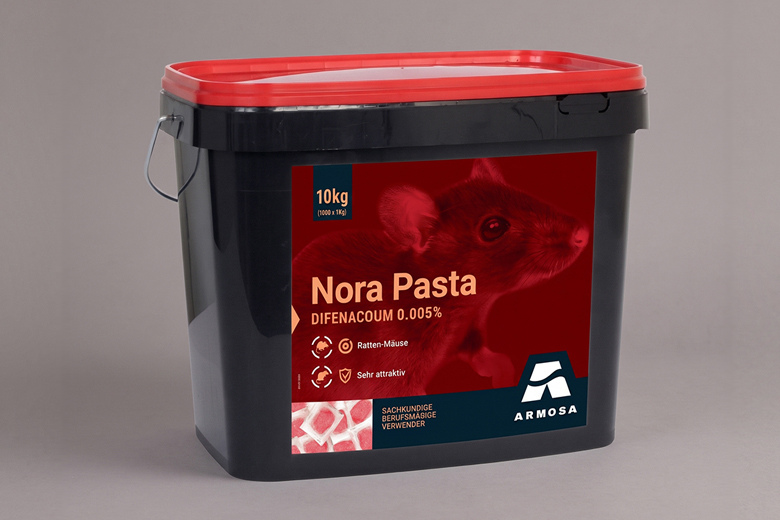
Brodifacoum is the most frequently named active ingredient in rodent control, and also the one most often misunderstood. It gets called instant, when it works over days. It gets treated as the default, when its very potency is what creates the main risk. Below is how it works, where its advantage lies, and why the right strategy is to hold it in reserve rather than use it as standard.
How it works
Brodifacoum is a second-generation coumarin anticoagulant. It inhibits the enzyme that regenerates the active form of vitamin K, and without it the liver cannot synthesise clotting factors II, VII, IX and X. The existing stock of factors in the blood is used up gradually, so the animal looks normal for several days and then clotting stops.
Two practical consequences follow. First, an untouched station on day three is not a failure but the normal course. Second, the delay is an advantage rather than a drawback, because the rodent never links the bait to danger and the colony keeps feeding on it.
| Stage | When | What happens |
|---|---|---|
| Feeding | Day 1 | An adequate dose is taken in a single feed |
| Latent period | Up to 18 hours | The existing stock of clotting factors is used up; no signs |
| Clinical signs | After 18 hours | Weakness, lethargy, laboured breathing; the rodent moves into the open |
| Death | 3 to 10 days | Internal haemorrhage |
| Liver residue | Weeks to months | The source of secondary poisoning for predators and pets |
How brodifacoum differs from the other anticoagulants
| Substance | Generation | Feeds to a lethal dose | Secondary poisoning risk |
|---|---|---|---|
| Brodifacoum | Second | One adequate feed | High |
| Flocoumafen | Second | One adequate feed | High |
| Difenacoum | Second | One adequate feed | Moderate |
| Bromadiolone | Second | One adequate feed | Moderate |
| Warfarin and relatives | First | Repeated feeding over several days | Low |
Every second-generation substance is lethal after a single adequate feed, so the difference between them is not speed but activity and persistence in the body. The more active the substance, the less of it is needed and the longer it stays in the liver, which means the higher the risk to non-target species. A detailed comparison is in our piece on brodifacoum or difenacoum.
When brodifacoum is genuinely needed
- Suspected resistance to weaker substances. The signs of genuine resistance: bait eaten readily, take consistently high for two or three weeks, numbers not falling, on a site where the same substance has been used for years.
- A large colony under heavy pressure. When numbers have to come down fast and reliably rather than simply be held.
- Sites where a mistake is expensive. Feed stores, hatcheries and product areas, where a rodent creates not just losses but a microbiological risk.
Everywhere else it is wiser to keep difenacoum as the baseline: it is adequate, cheaper in terms of risk, and it preserves brodifacoum as a reserve for when it is really needed.
Safety: three rules that remove most of the risk
- Bait always in a locked station, never loose. The station is fixed in place so it cannot be tipped or carried off.
- Carcasses collected daily and disposed of. An uncollected carcass is precisely the mechanism of secondary poisoning.
- Bait stock stored under lock, separate from feed, out of reach of children and animals.
The antidote in a pet poisoning is vitamin K1. It only works if given promptly, so any suspicion goes to a vet the same day. Because brodifacoum persists in the body the course can be long, and its duration is for the vet to decide.
Doses and placement in practice
In our range brodifacoum is supplied in Propasta, a soft blue paste enriched with fats, containing 4 mg of active per gram of product. The fatty base matters: it gives the bait a chance to win against the feed lying next to it.
| Target rodent | Dose per point | Minimum spacing | How many points |
|---|---|---|---|
| House mouse | 10 to 20 g | 2 m | Many, placed densely: activity radius 3 to 10 m |
| Brown rat | 50 to 60 g | 5 m | Few, but precisely on the run; activity radius 30 to 50 m |
The number of points matters more than the mass at each: twenty stations with 100 g are serviced faster and more effectively than five with 400 g. For rats, allow an extra 5 to 7 days for them to get used to the station: neophobia is a normal reaction, and moving the station daily cancels the treatment.
For the first two weeks check the stations every two to three days, to catch active feeding and top up in time. Once the take falls off, weekly is enough. Log every check: date, station number, amount taken, bait condition. Without the log you cannot see where pressure is building.
Responsible use
Second-generation anticoagulants are a tool with a known effect on non-target species, which is why European practice applies stewardship rules to them. The core principles are worth adopting on any holding regardless of formal requirements:
- Do not bait permanently. Permanent baiting selects for survivors and maintains a residual risk to predators. Bait is laid as a campaign, and once the colony is down the stations move to monitoring without product, or with non-toxic monitoring blocks.
- Start with prevention, not with poison. Closing entries, clearing spills and keeping a clear strip along the footings deliver a permanent effect, whereas bait works only while it is being laid.
- Keep the strongest substance in reserve. Use brodifacoum as your default and in a few years you will have nothing left to answer genuine resistance with.
- Collect carcasses daily. It is the cheapest action that most reduces risk to non-target species.
- Document it. A site plan with numbered stations, a check log, product data sheets and a staff training record are what any audit asks for, and what lets you work out what happened if something goes wrong.
What brodifacoum does not do
No active ingredient removes the reason a rodent came onto the site. With a free entry and access to feed, the stations will need servicing indefinitely and bait consumption will climb every year. Close openings over 6 mm with steel mesh or mortar, fit a brush threshold under gates, keep a 50 to 100 cm strip along the footings clear, and store feed in closed containers.
On building the system, see the farm rodent control programme. On choosing a bait format, see choosing a rodenticide bait. On resistance, see anticoagulant resistance in rodents.
Frequently asked questions
How much more potent is brodifacoum than other anticoagulants?
Brodifacoum is among the most active second-generation anticoagulants: a lethal dose for a rat is reached after a single adequate feed, whereas first-generation anticoagulants require repeated feeding over several days. That is why it is reserved for large colonies or where resistance to weaker substances is suspected.
Why does the rodent not die straight away?
Because the mechanism is not immediate. Brodifacoum blocks the regeneration of the active form of vitamin K, so the liver gradually stops producing clotting factors. Clinical signs appear roughly 18 hours after a toxic dose and death follows in 3 to 10 days. The delay is deliberate: the rodent does not associate the bait with danger.
What is secondary poisoning and why does it matter for brodifacoum in particular?
Brodifacoum accumulates in the rodent liver and persists there, so a poisoned rodent is a hazard to whatever eats it: a cat, a dog, a bird of prey. The more active and persistent the substance, the higher that risk. Hence bait only in locked stations and carcasses collected daily.
What is the antidote?
Vitamin K1, and it only works if given promptly, so any suspicion goes to a vet the same day rather than waiting for things to worsen. Because brodifacoum persists in the body, the vitamin K1 course can be long, and its duration is decided by the vet, not the owner.
When is brodifacoum needed and when is difenacoum enough?
Difenacoum is less potent but adequate for most farm situations, and its secondary poisoning risk is lower, which makes it the sensible baseline. You move to brodifacoum when there are signs of genuine resistance: bait eaten readily for two or three weeks while numbers do not fall.
Does resistance to brodifacoum develop?
Yes, by the same mechanism of VKORC1 gene mutation, but far less often than to first-generation substances and to difenacoum. That is exactly why brodifacoum is worth keeping as a reserve rather than using continuously: otherwise you spend your strongest tool and breed a resistant population.