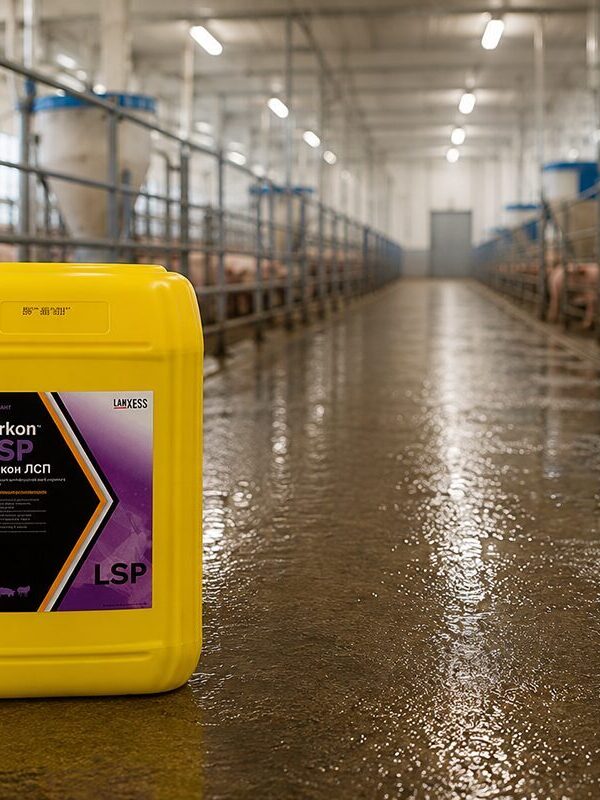
Virkon S (Virkon™ S): composition, mechanism of action and application regimes
A breakdown of the Virkon S formula, its six mechanisms of action, confirmation under EN standards, data on African swine fever virus and an independent caveat about porous concrete.

OLEKSANDR SHELYAG, veterinarian, Central Region sales director at WellFarm LLC
Virkon™ S is one of the few veterinary disinfectants around which there is not only the manufacturer’s marketing material but also independent peer-reviewed research. That is a rare situation in a market where most products are described in general phrases along the lines of “broad spectrum of activity”. What follows is an analysis of what the product is made of, how exactly it kills a pathogen, under which conditions that has been confirmed in the laboratory and - no less important - under which conditions it has not.
WellFarm LLC is the official and exclusive distributor of LANXESS in Ukraine, so the regimes given below correspond to the instructions in force for the Ukrainian market.

Composition: what actually does the work
Virkon S is not a single active substance but a balanced mixture of a peroxygen salt, organic acids, a surfactant and a buffer system.
| Component | Content | Function |
|---|---|---|
| Potassium peroxymonosulfate (triple salt) | 30-50 % per the safety data sheet; 50 g/100 g per the Ukrainian specification | The main oxidiser |
| Malic acid | 20-30 % | Acidic environment, denaturation of capsid proteins |
| Sulphamic acid | 5-10 % | Chlorine acceptor, stabilises the system |
| Sodium dodecylbenzenesulfonate | 1-5 % | Surfactant: surface wetting, disruption of the viral lipid envelope |
| Sodium chloride | about 1.5 % | Substrate for the formation of hypochlorous acid |
| Sodium hexametaphosphate | buffer | Sequesters hardness salts |
| Amaranth dye (E123) | trace amounts | Indicator of the solution’s remaining activity |
The working solution is acidic: the safety data sheet gives a pH of 2.5-3.0 for a 10 % solution. This is not a side characteristic but a condition of operation: the peroxymonosulfate triple salt is at its most active precisely at low pH.
Six mechanisms instead of one
The practical advantage of a multi-component formula is that the pathogen is attacked from several directions at once, and it is difficult for a microorganism to develop resistance to such a combination.
- Oxidation of sulphur bonds. The peroxygen component oxidises sulfhydryl and disulfide bonds in proteins and enzymes, disrupts cell membrane function and leads to rupture of the cell wall.
- Destruction of the lipid envelope. The surfactant dissolves the lipid envelope - which is why enveloped viruses, ASF virus among them, are the most vulnerable group.
- Denaturation of capsid proteins by the organic acids.
- Damage to nucleic acids by the peroxygen.
- Lowering the pH to values at which most pathogens lose structural integrity.
- Formation of hypochlorous acid directly in the solution. The sodium chloride is not an inert filler: peroxymonosulfate oxidises the chloride ion in a cyclical reaction, while sulphamic acid acts as a chlorine acceptor. In effect this is a sixth biocidal mechanism, and it starts in the bucket.
The pink colour as built-in verification
Amaranth dye in its oxidised form is pink. When the oxidising potential of the solution is spent - through organic contamination, dilution by rain, or simply time - the dye converts to its colourless reduced form. The manufacturer stresses that a situation where the solution has lost activity but kept its pink colour is not possible.
A practical rule. The solution retains activity for up to 7 days. If the solution in a barrier or a dip has lost its colour sooner, it is spent, regardless of how many days have passed since it was made up. This is the only disinfectant in a typical farm’s armoury that tells you itself when it has stopped working.
Spectrum and confirmation under European standards
The manufacturer declares the following results under EN standards - all at 10 °C, that is in cold conditions close to a real building in winter:
| Standard | What it assesses | Confirmed regime |
|---|---|---|
| EN 1656 | Bactericidal activity, veterinary field (E. hirae, P. hauseri, P. aeruginosa, S. aureus) | 0.5 % / 30 min |
| EN 1657 | Fungicidal activity (C. albicans) | 1.5 % / 60 min |
| EN 14349 | Bactericidal activity on surfaces | 0.5 % / 30 min |
| EN 14675 | Virucidal activity (ECBO test virus) | 0.5 % / 30 min |
| EN 16438 | Activity against yeasts on surfaces | 1.5 % / 60 min |
Note the difference between the regimes: bacteria and viruses are dealt with at half the concentration in half an hour, while fungi require three times the concentration and twice the contact time. A farm fighting mycoses cannot use the standard 0.5 % regime and expect a result.
African swine fever: what is proven and what is marketing
There are two different sets of figures for efficacy against ASF virus, and they are regularly confused.
The first set is a LANXESS press release from September 2020: ASF virus inactivated in 15 seconds at a dilution of 1:100. The test conditions - temperature, organic load, water hardness, virus strain, log reduction achieved - are not disclosed.
The second set comes from testing at the Animal Health Research Centre CISA/INIA (Madrid), the EU reference laboratory for ASF, using EN 14675 adapted to ASF virus. The conditions were deliberately harsh: heavy organic soiling, hard water, 10 °C. The result: Virkon S completely inactivates the virus at a dilution of 1:200 over 5 minutes.
Which figure to base a protocol on. The five-minute one, under the CISA/INIA conditions. It was obtained under known and worst-case conditions - exactly the kind that occur on a farm. A 15-second figure with undisclosed conditions cannot be the basis for calculating contact time: planning a clean-out around it means building in no margin at all.
Independent confirmation also exists outside the manufacturer’s laboratory. In a study by McCleary and colleagues (2021), carried out to validate procedures in biological containment laboratories, a 1 % solution of Virkon S completely inactivated ASF virus in 30 seconds of contact. Work by Frost and colleagues (2023) in the journal Pathogens showed that peroxygen products based on potassium peroxymonosulfate at a dilution of around 1:800 delivered a reduction in ASF virus titre of more than 3.3-4.5 log10 across temperatures of 4-20 °C and contact times of 5-30 minutes, in hard water at 400 ppm CaCO₃. An important caveat: no organic load was applied in that study and the products were anonymised by letter, so the result cannot be transferred directly to a specific trade name.

Porous concrete: the most important caveat
The most valuable result for a practitioner comes not from a press release but from work by Gabbert, Neilan and Rasmussen (2020) in the Journal of Applied Microbiology. The authors tested whether a disinfectant performs equally on different surfaces.
- On stainless steel, a 1 % solution of Virkon S completely destroyed ASF virus (strain BA71V).
- On porous concrete, the same 1 % solution over 10 minutes left three of four samples positive by cytopathic effect - the virus survived.
- Complete inactivation on concrete was achieved only at 2 % and 5 %.
- Foot-and-mouth disease virus (strain A24) under the same conditions was inactivated on concrete at 1 % in 5 minutes.
The conclusion for a farm is direct: a pen’s concrete floor, an outdoor yard, a rough wall - none of these is stainless steel. A regime confirmed on a smooth surface does not guarantee a result on porous concrete. When working on concrete under an ASF threat, the concentration should be raised rather than economised on. A further point: no data under EN 16437, which assesses bactericidal activity specifically on porous surfaces in the veterinary field, could be found for this product in open sources - that is a real gap in the evidence, and it is more honest to say so plainly.
Instructions for use: concentrations and regimes
Below are the regimes from the instructions in force for the Ukrainian market, together with the manufacturer’s typical regimes. The application rate of working solution for surfaces is 300 mL per square metre; the surface is wetted thoroughly.
| Task | Concentration | Contact time |
|---|---|---|
| Routine disinfection of buildings | 0.5 % (1:200) | 30 min |
| Emergency (final) disinfection | 1 % (1:100) | 2-3 h |
| Barriers, foot dips, wheel baths | 1 % (1:100) | replace weekly or when the colour goes |
| Drinking systems, final treatment | 1 % (1:100) | 1-2 h, up to 12 h where needed |
| Drinking water, continuous dosing | 0.1 % (1:1000) | continuous |
| Aerosol treatment of an empty building | 1 % (1:100), 1 L per 10 m³ | 30-60 min |
| Aerosol with stock present | 0.5 % (1:200), 20 mL per m³ | per label |
For reference, the statutory UK DEFRA rates often quoted in the technical literature: general orders - 1.34 % (1:75); diseases of poultry and avian influenza - 0.67 % (1:150); foot-and-mouth disease - 0.08 % (1:1300); swine vesicular disease - 1.00 % (1:100).
Use with animals present
There is a divergence between jurisdictions here. The European-style label explicitly permits use with animals present - by spraying a 0.5 % solution; the manufacturer recommends aerosol treatment at 1:200 two to four times a day with stock in the building. The US-style label, by contrast, requires animals to be removed and surfaces dried before they return. For a Ukrainian farm the reference point is the European-type instruction under which the domestic market operates.
More on which classes of disinfectant are acceptable at all around livestock in the separate article on disinfection in buildings with animals present.
Material compatibility, safety, environment
- Metals. Not to be used on brass or copper. Contact time with metal items is limited to 10 minutes (up to 20 minutes in anti-tuberculosis protocols). Incompatible with strong alkalis, oxidisers and acids.
- Plastics and non-metallic materials - compatible; temporary pink staining is possible and washes off.
- Biodegradability. About three quarters of the composition is inorganic components that break down to potassium salts and oxygen; the organic components are classified as readily biodegradable (for malic acid the safety data sheet gives 67.5 % degradation in 28 days).
- Aquatic organisms. The LC50 of peroxymonosulfate for fish is around 53 mg/L. Run-off after treatment must not reach water bodies.
- Operator safety. The current CLP/GHS classification of the concentrate: skin irritation category 2; serious eye damage category 1; signal word “Danger”. PPE: butyl gloves, close-fitting safety goggles, respiratory protection when handling the powder.
An outdated statement still circulating online. Old Antec International material describes the product as non-irritating to skin and eyes. That referred to the 1 % working solution and contradicts the current classification of the concentrate. Handle the powder as a substance labelled “Danger”, not according to texts twenty years old.
Five mistakes that waste the treatment
- Disinfecting without washing first. Organic matter binds the oxidiser before it reaches the pathogen. Peroxygens lose activity in dirt faster than phenolics. First dry cleaning, soaking, foam, rinsing, drying - and only then the disinfectant. Alkaline foam detergents and acid products for removing limescale are made for that stage.
- Treating a wet surface. Residual water dilutes the working solution right there on the surface. Drying is a required stage, not a formality.
- Under-applying. 300 mL per square metre is thorough wetting, not a freshening mist from a knapsack sprayer.
- A solution older than a week, or a colourless solution in a barrier. The pink colour exists precisely so that this is noticed without a laboratory.
- The same regime for concrete and for metal. Gabbert and colleagues showed these are different tasks.
Where Virkon S falls short
No disinfectant is universal. Peroxygens are noticeably more sensitive to organic load than phenolics and burn out faster on a dirty surface. On open areas in direct sun the working solution degrades faster. In those scenarios a phenolic product makes more sense - Virkon LSP, for instance, which depends less on organic soiling and is intended for outdoor liquid barriers and treating vehicle wheels. In drinking systems, on the other hand, phenolics have no place at all - only Virkon S works there.
Manufacturer’s catalogue
Below are pages from the official LANXESS Virkon S catalogue in its Ukrainian-language edition.

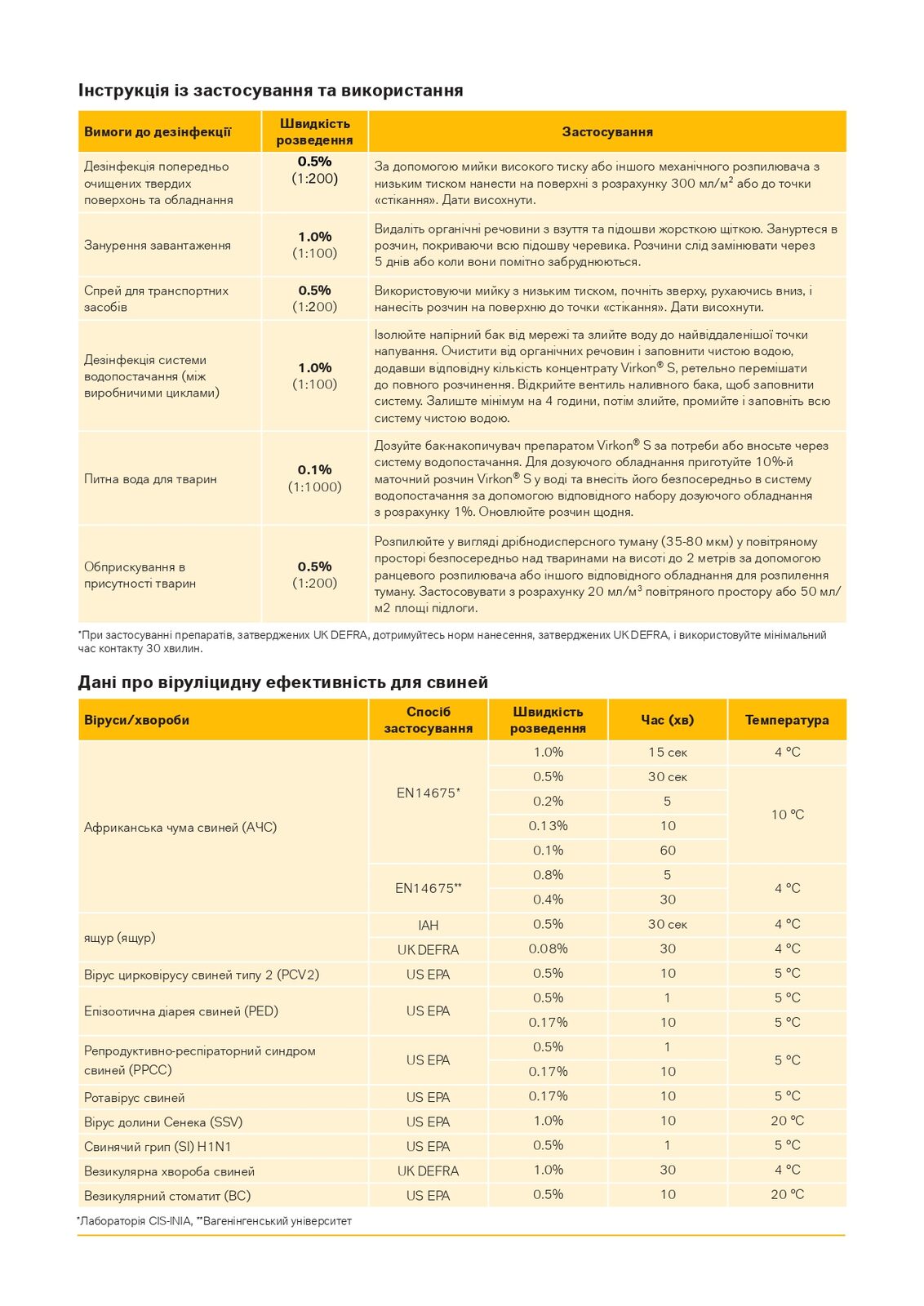
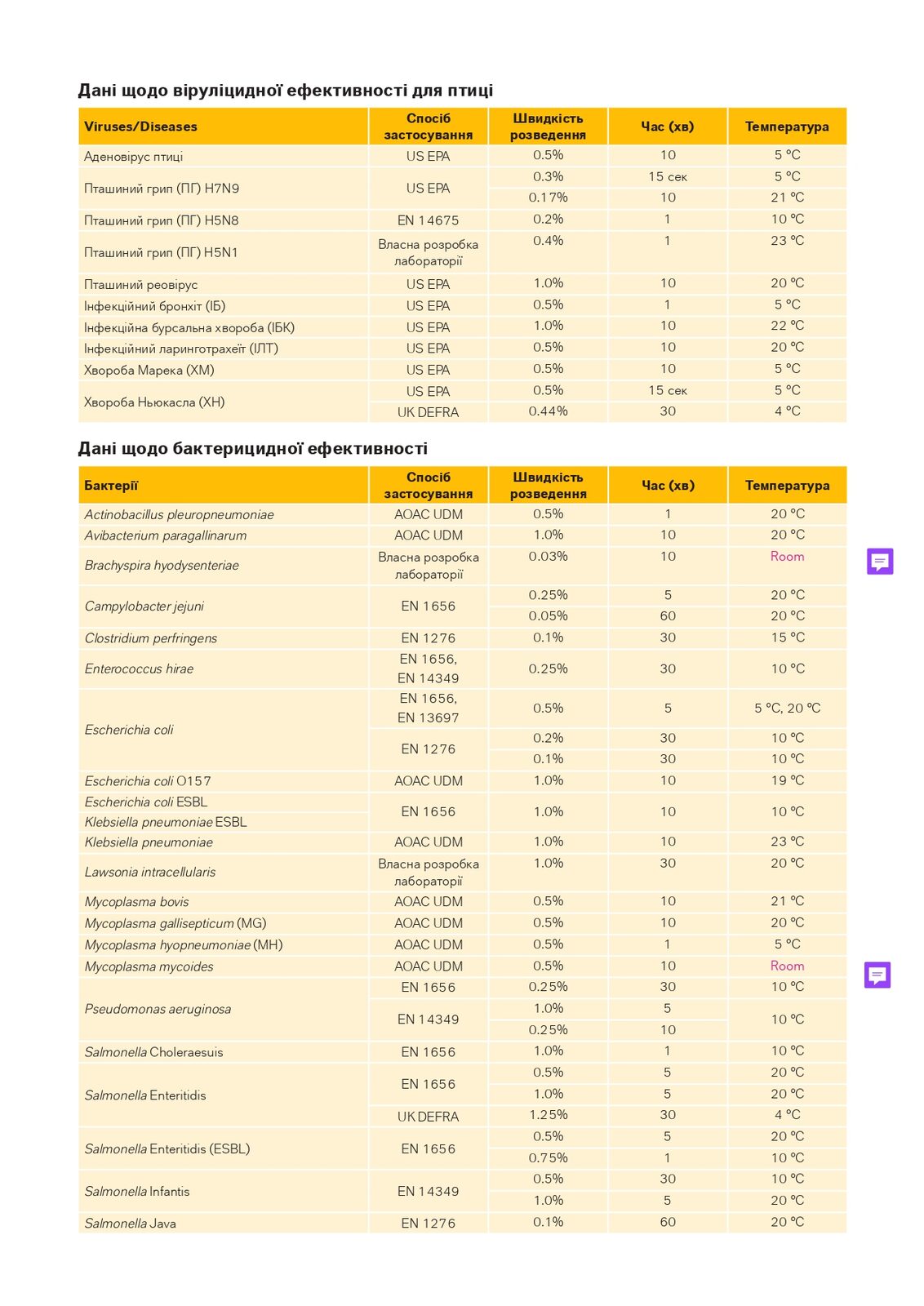

Product page with current pack sizes and supply terms: VIRKON S.
Read also
Products for this task are in the Disinfectants section.
Sources
- LANXESS. Virkon® S - product page, DEFRA approval rates.
- LANXESS / Syndel. Safety Data Sheet VIRKON™ S, version 2.0, 31.07.2024.
- Antec International. Virkon Background Information - mechanism of action, indicator system, material compatibility.
- LANXESS. Virkon S - table of EN standard test results (European-style label).
- LANXESS AG. New tests prove LANXESS Virkon S and Virkon LSP highly effective against ASF. Press release, October 2020 (CISA/INIA testing under EN 14675).
- LANXESS AG. African Swine Fever: Virkon S disinfectant with proven efficacy in just 15 seconds. Press release, 18.09.2020.
- Gabbert L.R., Neilan J.G., Rasmussen M. Recovery and chemical disinfection of foot-and-mouth disease and African swine fever viruses from porous concrete surfaces. Journal of Applied Microbiology, 2020; 129(5):1092-1101. DOI 10.1111/jam.14694.
- Frost L., Tully M., Dixon L. et al. Evaluation of the Efficacy of Commercial Disinfectants against African Swine Fever Virus. Pathogens, 2023; 12(7):855. DOI 10.3390/pathogens12070855.
- McCleary S., McCarthy R.R., Strong R. et al. Inactivation of African Swine Fever Virus by reagents commonly used in containment laboratories. Journal of Virological Methods, 2021; 295:114203.
- Beato M.S., D’Errico F., Iscaro C. et al. Disinfectants against African Swine Fever: An Updated Review. Viruses, 2022; 14(7):1384.
- Order of the Ministry of Agrarian Policy of Ukraine No. 69 of 20.06.2007, “Instruction on sanitary treatment of poultry facilities” - working solution application rates.
Note. Regimes are given for reference. Before use, follow the instructions supplied with the specific batch of product and the requirements of the State Service for Food Safety and Consumer Protection. Concentrations for emergency disinfection against a specific disease are agreed with the farm’s veterinarian.