Rodents as a reservoir of infection on the farm: 77 pathogens and the real cost
Prevalence of Leptospira, Salmonella, Campylobacter and Toxoplasma in farm rodents, economic losses well beyond the value of eaten feed, and a correction on PRRS that contradicts a common claim.
OLEKSANDR SHELYAG, veterinarian, Central Region sales director at WellFarm LLC
Losses to rodents are usually counted in eaten feed. That is the smallest part of the bill. A 2026 systematic review pooling 204 bacteriological, 166 parasitological and 92 virological studies counted 77 pathogens carried by rodents on livestock premises. Any one of them can cost more than all the feed they eat put together.

What rodents actually carry: figures by species of livestock
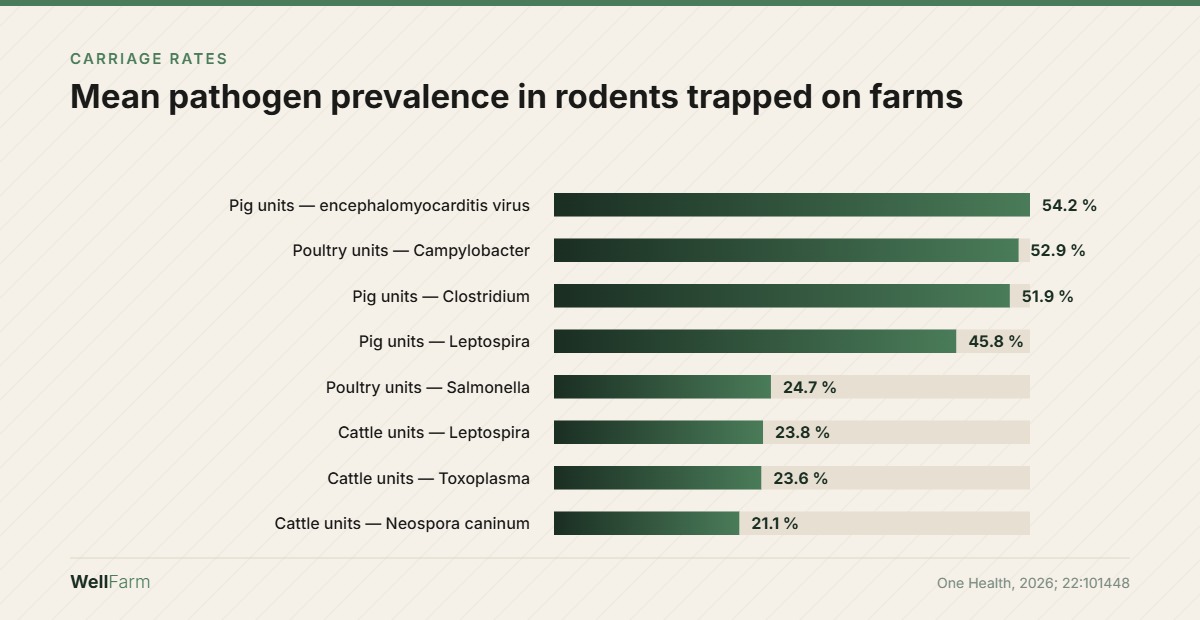
Mean prevalence of pathogens in rodents trapped on farms:
| Premises | Pathogen | Mean prevalence |
|---|---|---|
| Cattle farms | Leptospira | 23.8 % (19 studies) |
| Cattle farms | Toxoplasma | 23.6 % |
| Cattle farms | Neospora caninum | 21.1 % |
| Pig units | Encephalomyocarditis virus | 54.2 % |
| Pig units | Clostridium | 51.9 % |
| Pig units | Leptospira | 45.8 % |
| Poultry units | Campylobacter | 52.9 % |
| Poultry units | Salmonella | 24.7 % |
Every second rat on a pig unit carries Leptospira. Every second mouse on a poultry unit carries Campylobacter. These are not isolated finds but averages across dozens of studies.
Leptospirosis
A global review covering 145 studies in 62 locations puts Leptospira prevalence at 30.3 % in the Norway rat and 17.8 % in the black rat. In Europe the Icterohaemorrhagiae and Sejroë serogroups dominate.
For a farm this means continuous risk through rodent urine reaching feed, litter and surfaces. It is also a zoonotic risk to staff - leptospirosis is an occupational disease of livestock workers.
Toxoplasmosis and neosporosis
A Danish study of indoor sow herds found Toxoplasma gondii DNA in 8 % of mice (11 of 137) on 11 % of the 56 farms examined - against a seroprevalence of 34 % in Danish pigs.
The most interesting result of that study was something else: the probability of trapping mice, and of finding Toxoplasma carriers among them, was significantly higher on farms that carried out additional rodent control. The explanation is that chemical treatment is triggered as a reaction to an existing problem rather than as prevention of one.
Campylobacteriosis
Here the link to performance is clearest. In broiler flocks where mice were recorded, Campylobacter detection stood at 40 % against 23 % in flocks without rodents. Campylobacter jejuni was found in 87 % of rat faecal samples.
A study on Dutch organic farms gave Campylobacter prevalence of 9.6 % in house mice and 12.5 % in brown rats, and Salmonella of 1.2 % in mice. One detail matters: all the positive samples came from stores, feed passages and the external area, not from the housing itself. The key control point is not where the animals stand but where the feed is kept.
Swine dysentery
The Merck Veterinary Manual is unambiguous: rodents and waterfowl are important reservoirs of Brachyspira spp., and any eradication attempt must include eliminating or reducing contact with these reservoirs on the farm. A dysentery control programme without rodent control is incomplete by definition.
Porcine epidemic diarrhoea
Recent 2025 data: PEDV genome was detected in 6 of 39 rat faecal samples taken on pig farms in 2020-2022. Rats shed virus and had higher intestinal titres than mice. Natural rodent-to-pig transmission has not, however, been demonstrated experimentally - for now this indicates a risk rather than a proven mechanism.
What rodents do not carry: an important correction on PRRS
A widespread claim that is not supported. Industry material often states that rodents spread porcine reproductive and respiratory syndrome virus. The reference experimental study reached the opposite conclusion: rodents are not susceptible to infection with PRRS virus and are therefore unlikely to be a reservoir of the disease. No publications confirming mechanical transmission of the virus by rodents could be found. For PRRS the evidence is far better for the house fly.
This correction matters: a biosecurity programme against PRRS should not be built around rodent control - other levers work there. Against Salmonella, Campylobacter, leptospirosis and dysentery, on the other hand, rodent control is a direct tool.
Direct economic losses
- An adult rat eats 28-57 g of feed a day, a mouse about 3 g. A population of 200 rats destroys roughly 4.6 tonnes of feed a year.
- Researchers, however, put real losses including contamination and spoilage at around USD 25 per rat per year - several times the value of what is eaten.
- Storage losses in grain products to commensal rodents typically run at 1-15 %.
- According to FAO, the cost-benefit ratio of organised control programmes ranges from 1:2 to 1:30.
- Gnawed cables, damaged insulation, curtain film, cooling pads and egg belts: damaged insulation means permanent energy loss, and damaged wiring is a fire risk.
How many there really are
A rule of thumb from US poultry guidance: for every rodent seen, an estimated 20 to 50 go unseen. Activity in daylight means high population density - rodents are nocturnal by nature, and coming out by day indicates competition for resources.
The signs used to assess an infestation: droppings, smears and grease marks along walls, gnawing, burrows, tracks in dust, noises in voids, smell, and uptake of non-toxic monitoring blocks.
What this means for the programme
- Rodent control is part of the infection control programme, not a housekeeping detail. It should be planned together with the cleaning protocols, not separately.
- The main point of effort is stores, feed passages and the external perimeter, not the housing: that is where studies find the positive samples.
- Control has to be continuous: occasional treatment triggered by a visual sighting is several population cycles too late.
- Non-chemical measures come first: sealing openings, removing harbourage, clearing feed spills. Without them, chemistry only lowers numbers temporarily.
- Records are mandatory - both as a condition of managing the programme and as an element of permanent procedures based on HACCP principles.
How to build such a programme is covered in the article on farm rodent control; the choice of active substances and bait formats in the article on difenacoum and brodifacoum. For permanent perimeter stations, moisture-resistant paraffin blocks are convenient; for indoor areas, soft paste.
Read also
Products for this task are in the Rodenticides section.
Sources
- Huels A., Jacob J. Rodent-borne pathogens as economic and zoonotic health threat to livestock farming: a review. One Health, 2026; 22:101448.
- Boey K., Shiokawa K., Rajeev S. Leptospira infection in rats: A literature review of global prevalence and distribution. PLOS Neglected Tropical Diseases, 2019.
- Nielsen et al. The prevalence of Toxoplasma gondii in mice living in Danish indoor sow herds. Acta Veterinaria Scandinavica, 2019.
- Meerburg B.G., Jacobs-Reitsma W.F., Wagenaar J.A., Kijlstra A. Presence of Salmonella and Campylobacter spp. in Wild Small Mammals on Organic Farms. Applied and Environmental Microbiology, 2006; 72:960-962.
- Meerburg B.G. Rodents are a risk factor for the spreading of pathogens on farms. Veterinary Microbiology, 2010; 142(3-4):464-465.
- Merck Veterinary Manual. Swine Dysentery, 2026.
- Chen J., Wang Z., Lin S. et al. Insights into cross-species infection: Porcine epidemic diarrhea virus infections in the rodent. Virologica Sinica, 2025.
- Hooper C.C., Van Alstine W.G., Stevenson G.W., Kanitz C.L. Mice and Rats (Laboratory and Feral) are not a Reservoir for PRRS Virus. Journal of Veterinary Diagnostic Investigation, 1994.
- Tabler T. et al. Controlling Rodents on the Poultry Farm. Mississippi State University Extension Service, 2017.
- Witmer G. Rodents in Agriculture: A Broad Perspective. Agronomy, 2022; 12(6):1458.
- FAO. Grain storage techniques - Rodent control: the economic importance of rodent pests.
Note. The prevalence figures cited come from international studies and serve as an indication of the scale of risk. A control programme for a specific site is developed by the farm’s veterinary service.