Farm rodent control: why a rodenticide on its own does not work
The four components of a working rodent control programme, station placement based on rat and mouse biology, bait formats and record-keeping. Why chemistry without engineering gives only a temporary result.
A 2023 UK survey found that 84 % of farmers had a rat or mouse problem during the previous year, and around 40 % felt control had become harder - mostly citing resistance. Resistance is real, but it explains a smaller share of failures than is generally assumed. Far more often the cause is different: the rodenticide is used as the only tool, when by its nature it can only be one of several.
The wording of the UK CRRU code of best practice is blunt: relying on rodenticides alone does not guarantee that an infestation will be eliminated, and killing rodents can deliver only short-term control.
The data that explain the problem
A Danish study of mice in indoor sow herds produced a result that looks paradoxical at first: the probability of trapping mice, and of finding Toxoplasma gondii carriers among them, was significantly higher on farms that carried out additional rodent control.
The explanation is simple, and it is also a diagnosis of industry practice: chemical treatment starts once rodents have become visible. It is a reaction to an infestation rather than its prevention. Review papers record the same thing: farm control programmes are usually triggered after a subjective population threshold is crossed, and are often carried out poorly.
The core point. A rodenticide reduces numbers. It does not change what makes your site attractive to rodents. While the carrying capacity of the environment stays the same, the population returns to its former level - and all you have bought is a bill for bait and selective pressure in favour of resistant individuals.
Four components without which the chemistry does not work
1. Exclusion
Physical parameters worth knowing by heart. An American reference gives a rat using openings over 13 mm and a mouse over 6 mm; a British guide for food premises gives stricter figures - rat over 6 mm, mouse over 5 mm. The two scales contradict one another, so design to the stricter number.
- Against rats - 13 mm mesh of 19-gauge wire; against mice - 6 mm of 24-gauge wire.
- Foundation walls are taken at least 900 mm below ground level.
- Every pipe, cable or duct penetration is sealed with cement or a metal collar.
- Gaps under doors are reduced to less than 5 mm with brush seals.
- Drainage is designed to be rat-proof; ceramic pipes are more reliable than plastic against rats emerging from the network.
2. Removing harbourage
Wall voids, suspended ceilings, stacks of pallets, piles of unused equipment, vegetation within 2-5 m of buildings. Recommended practice is a strip about 900 mm wide along the foundation kept clear of vegetation, and goods stored at least 450 mm off the floor with free access to the walls.
3. Controlling spilt feed
The most important and the cheapest item. Research on the feeding behaviour of the Norway rat on farms states it directly: bait uptake is ultimately determined by the living conditions available in that particular area. If spilt compound feed, silage or accessible waste lies next to the station, bait of any quality loses the competition.
Hence the rule: before bait goes down, clear feed spills, seal hoppers, repair augers and put waste in metal containers with tight lids.
4. Monitoring instead of permanent poison
Non-toxic monitoring blocks or paste in stations let you see rodent activity before it becomes visually obvious, and show where bait should actually go. Keeping toxic bait permanently in stations “just in case” is a practice European regulation is steadily moving away from.
How to place the stations
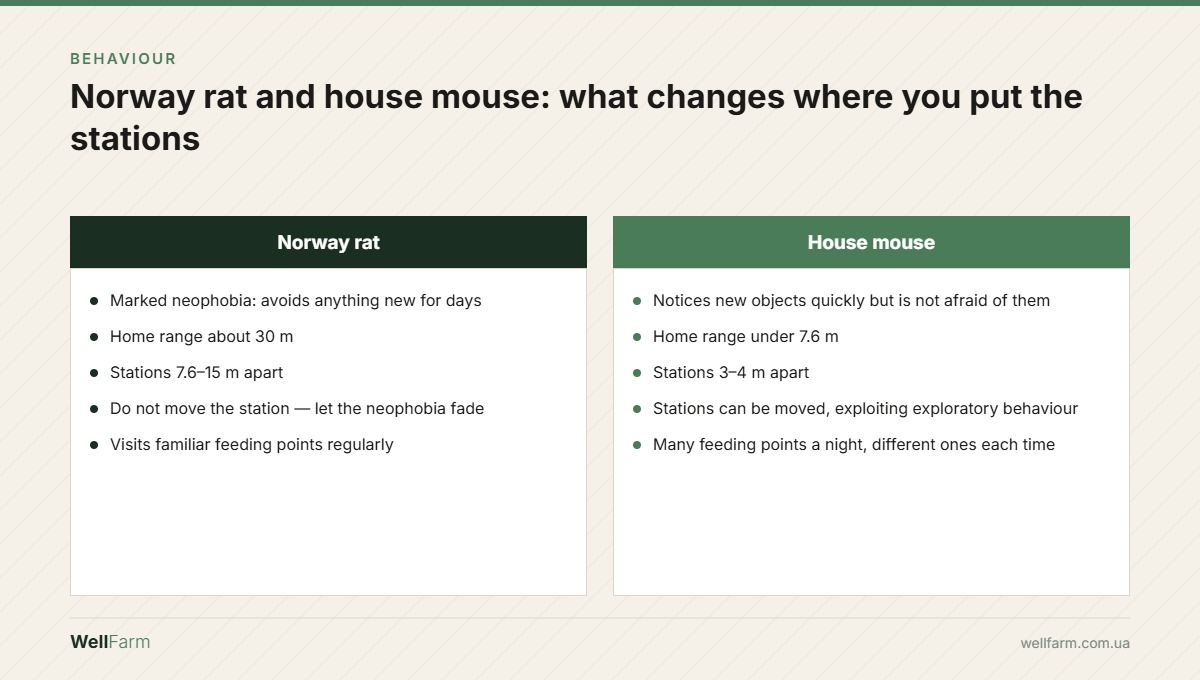
What governs this is biology, not an even grid.
| Parameter | Norway rat (Rattus norvegicus) | House mouse (Mus musculus) |
|---|---|---|
| Attitude to a new object | Marked neophobia: avoids anything new for days | Notices new objects quickly, but is not afraid of them |
| Home range | about 30 m | under 7.6 m |
| Spacing between stations | 7.6-15 m | 3-4 m |
| Tactics | Do not move the station: let the neophobia fade | Stations can be moved, exploiting exploratory behaviour |
| Feeding pattern | Visits familiar points regularly | Many points a night, different ones each time |
One separate fact explains a great many failures: neophobia towards the container itself can extend the time to poisoning by up to 14-fold compared with a situation where only the food is new. The rat may be avoiding not the bait but the box. The practical conclusion is that stations go out in advance and stay in place, rather than arriving with the bait on treatment day.
They are placed along walls, on identified runs - found by droppings, tracks, smears and gnawing - and fixed to the floor or wall. A station has to be protected against unauthorised opening: resistant to attempts by dogs and children under six, lockable or sealable, and outdoors able to withstand sun, temperature swings, humidity, rain and snow.
Bait formats for different conditions
| Format | Strengths | Where it fits |
|---|---|---|
| Paraffin blocks - PROBLOK | Up to 40 % wax: resistance to mould and moisture, durability, a fixed weight for measuring uptake | Damp areas, the external perimeter, drains, long-term placements |
| Soft paste - NORA PASTA, PROPASTA | High palatability, especially for mice that take small amounts at many points; easy portioning | Indoors, and areas with heavy competition from feed |
| Grain and pellets | Closest to the natural diet, reduces neophobia | Outdoor sites; not used where there is any risk of it reaching feed |
The records that make the programme manageable
The code of best practice requires recording bait point locations, product names, quantities, a site plan and inspection dates, along with mandatory searching for and disposal of dead rodents. For a Ukrainian farm this is also a matter of compliance with requirements for permanent procedures based on HACCP principles, where pest control is a prerequisite programme.
A minimum log: station number, inspection date, degree of uptake, product and quantity, signs of activity found, action taken, operator’s signature.
A typical annual scheme
- Survey. Map the site, look for signs of activity, entry points and harbourage.
- Engineering measures. Seal openings, fit mesh and seals, clear harbourage and vegetation.
- Install stations with non-toxic monitoring - at least a week before any bait is used.
- Assess activity from uptake of the monitoring blocks: bait goes where they are being eaten.
- Treat with the appropriate bait format until uptake stops.
- Return to monitoring and keep the stations under continuous check.
- Synchronise with the downtime: check and re-charge the stations at every change of batch, while the building is empty.
Why this order cannot be rearranged
Reviews of rodents in agriculture record that where a single control method is used, rodents adapt by various routes - and it was mass use of first-generation anticoagulants that produced physiological resistance in the first place. A programme built purely on chemistry therefore creates, over time, the very problem it later suffers from.
How the anticoagulants themselves work, and how difenacoum differs from brodifacoum, is covered in the next article in this series.
Read also
Products for this task are in the Rodenticides section.
Work it out for your farm. The rodent bait calculator shows the number of bait points along the building perimeter and the bait needed for mice and rats.
Sources
- CRRU UK. Code of Best Practice: Best Practice and Guidance for Rodent Control and the Safe Use of Rodenticides, 2024.
- Witmer G. Rodents in Agriculture: A Broad Perspective. Agronomy, 2022; 12(6):1458.
- Nielsen et al. The prevalence of Toxoplasma gondii in mice living in Danish indoor sow herds. Acta Veterinaria Scandinavica, 2019.
- Meerburg B.G. Rodents are a risk factor for the spreading of pathogens on farms. Veterinary Microbiology, 2010; 142(3-4):464-465.
- Klemann N., Pelz H.-J. Studies on food selection behaviour of the Norway rat (Rattus norvegicus) on farms. Journal of Pest Science, 2005; 78(1):45-52.
- Clapperton B.K. A review of the current knowledge of rodent behaviour in relation to control devices. Science for Conservation 263, Department of Conservation, 2006.
- Baker R.O., Bodman G.R., Timm R.M. Rodent-Proof Construction and Exclusion Methods. University of Nebraska-Lincoln, 1994.
- Acheta Consulting Ltd. The importance of building design and proofing in the management of rodent and insect pests in food premises, 2018.
- BASF Professional & Specialty Solutions. Research reveals UK farms are plagued by rodent problems, 2023.
- Tabler T. et al. Controlling Rodents on the Poultry Farm. Mississippi State University Extension Service, 2017.
Note. Rodenticides are used in accordance with the manufacturer’s instructions and current Ukrainian law. The parameters given are for reference.