Drinking water quality on the farm: what to test and what to do with the result
Benchmarks for microbiology, pH, hardness, iron and nitrates, why the sample must come from the end of the line rather than the borehole, and how each parameter affects product performance.
Water is by volume the largest “feed” on a farm: an animal consumes two to three times more of it than of the dry matter in its ration. Yet the ration is analysed regularly while the water is usually analysed once, when the borehole was drilled, and never again. And it is the water parameters that decide whether a water-soluble product will work, whether the disinfection system will perform, and how quickly the drinking line fouls.
What to test for
A water analysis for a farm is not the same set of parameters as for human drinking supply. Reference values for poultry, from University of Georgia recommendations built on EPA methodology:
| Parameter | Average acceptable | Maximum | What exceeding it causes |
|---|---|---|---|
| Total bacterial count | 0 /mL | 100 /mL | Contamination of the line, biofilm |
| Coliform bacteria | 0 /mL | 50 /mL | Faecal contamination of the source |
| pH | 6.8-7.5 | up to 8.0 | Above 7 the efficacy of hypochlorite falls sharply |
| Hardness (CaCO₃) | 60-180 ppm | over 110 ppm - watch zone | Limescale, precipitation of products, reduced disinfectant action |
| Iron | 0.2 mg/L | 0.3 mg/L | Iron bacteria, dense deposits, off-taste |
| Nitrates (as nitrogen) | 10 mg/L | 25 mg/L | Toxicity, a sign of effluent contamination |
| Sulphates | 32 mg/L | 250 mg/L | Laxative effect, reduced intake |
For other species the ranges are wider. Consolidated recommendations (based on the Canadian CCME guidelines) for farm livestock put acceptable total dissolved solids at up to 3,000 mg/L, sulphates up to 1,000 mg/L, nitrates plus nitrites up to 100 mg/L, and suggest a coliform benchmark below 100 per 100 mL. The overall pH tolerance range for farm animals is roughly 5.5-6.0 to 8.0-8.5.
For manganese there is no single agreed standard in the sources reviewed, although in practice it behaves much like iron: dark deposits, off-taste, and it feeds a specific microflora.
Where to take the sample: the question that decides everything
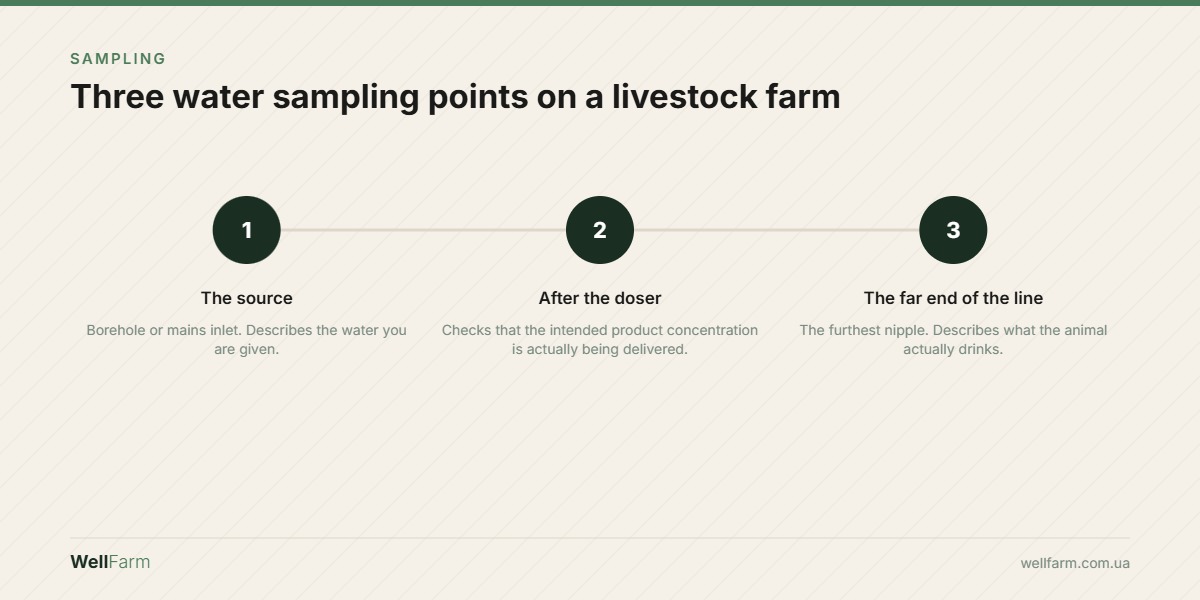
An analysis from the borehole describes the source. An analysis from the end of the drinking line describes what the animal actually drinks. These are different things, and the difference between them is a measure of how contaminated your system is.
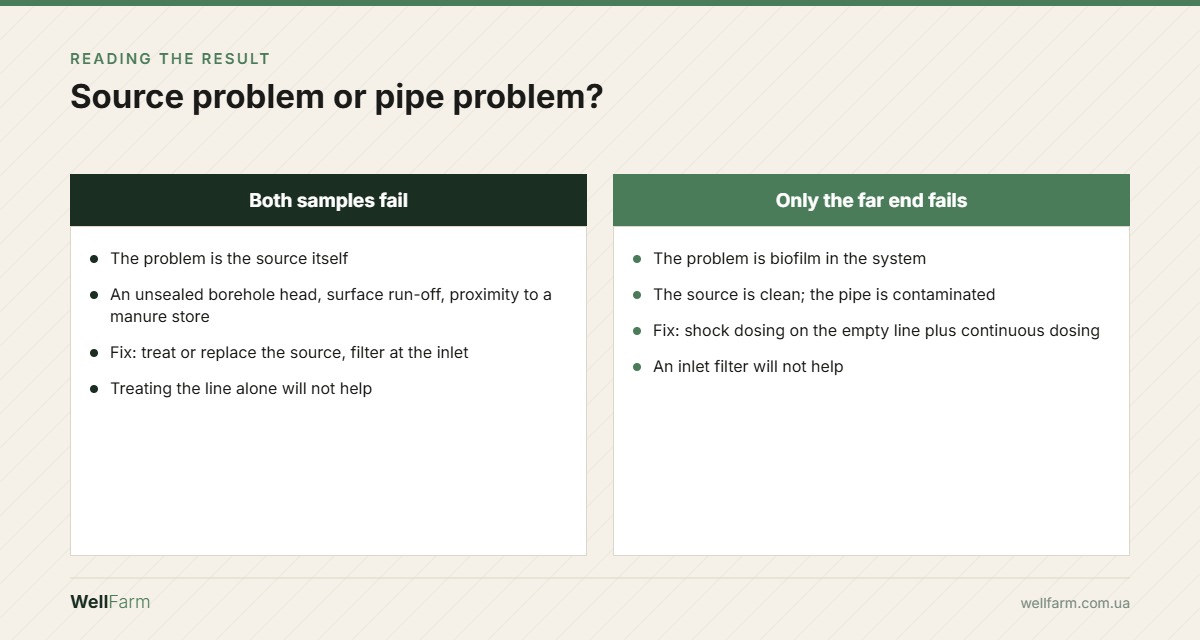
The minimum sampling scheme. Two samples at the same time: one from the source (borehole, inlet), one from the furthest nipple in the building. If the source is clean and the end of the line is not, the problem is not the water but the pipe - and it is solved by treating the system, not by fitting a filter at the inlet.
A useful third sample comes from just after the doser, to check that the intended product concentration is actually being delivered.
How to read the result and what to do
High hardness
Calcium and magnesium form limescale on the inner surface of pipes, in pressure regulators and in nipples. A rough layer builds up under the scale, and in its micropores microorganisms are protected from any disinfection. Hardness salts also bind some water-soluble products, reducing their availability.
What to do: periodic acid flushing of the line between batches (separately from oxidative treatment - the two must not be mixed), and water softening at the inlet where needed. The same principle applies to building surfaces, where acid detergents such as FORMISAN deal with mineral deposits.
High pH
The most common hidden problem in Ukrainian boreholes. If you disinfect water with hypochlorite, at a pH above 7 a large share of the chlorine you dose does nothing: the equilibrium shifts from hypochlorous acid to the far less active hypochlorite ion.
Two ways out: acidify the water before chlorination, or switch to chemistry that is insensitive to pH. The redox potential of chlorine dioxide is practically independent of pH across the 4-8 range, so DIXCHLOR keeps working where hypochlorite loses efficacy.
Iron and manganese
As they oxidise they produce brown and dark deposits and feed iron bacteria, which form particularly dense slimy layers. The answer is oxidation followed by filtration at the inlet; disinfection without removing the iron gives only a temporary effect.
Microbiology
Exceeding the total count or coliform limits at the source means a problem with the source itself: an unsealed borehole head, surface run-off, proximity to a manure store. Exceeding them only at the end of the line means biofilm - and then the two-stage scheme applies: shock treatment of the empty line and continuous dosing during the flock. Covered in detail in the article on biofilm in drinking water lines.
Nitrates
Raised nitrate levels in borehole water on a livestock site almost always mean effluent infiltration. This is not solved by treating the water - the source of contamination has to be found and removed.

Why hardness also affects building disinfection
The water you dilute a disinfectant with is as much a variable as the concentration. In a study of the efficacy of commercial disinfectants against ASF virus, the tests were deliberately run in hard water at 400 ppm CaCO₃ - precisely because that reflects conditions on most farms. Products containing sequestrants such as hexametaphosphate or EDTA tolerate hard water considerably better than simple formulations.
The practical conclusion: if your water is hard, that should be a criterion when choosing a disinfectant, not a footnote in small print.
A routine worth introducing
- A full water analysis (microbiology plus chemistry) at least once a year, from two points: the source and the end of the line.
- A repeat analysis after any change of source, repair to the system or change in the treatment scheme.
- Day-to-day monitoring of residual disinfectant concentration - at the furthest nipple, not at the doser.
- A log: date, sampling point, result, action taken.
- Shock treatment of the empty line at every change of batch.
- Acid flushing against mineral deposits on a schedule set by water hardness.
Read also
Products for this task are in the Disinfection of water section.
Sources
- Poultry Environmental Quality Handbook, University of Georgia. Drinking Water Quality: Protecting Your Birds Health and Performance, 2023.
- NDSU Extension. Livestock Water Quality: A Field Guide for Cattle, Horses, Poultry and Swine.
- NDSU Veterinary Diagnostic Laboratory. Water pH Values for Livestock.
- The Mechanism of Action of Chlorine Dioxide: A Narrative Review, 2025; 6(5):91.
- WATTAgNet. 4 ways to manage biofilm in poultry drinking water.
- Frost L. et al. Evaluation of the Efficacy of Commercial Disinfectants against African Swine Fever Virus. Pathogens, 2023; 12(7):855 - testing in hard water at 400 ppm CaCO₃.
Note. The values given are reference points from international industry guidance. Mandatory water quality requirements for a specific site are set by current Ukrainian law and by the State Service for Food Safety and Consumer Protection.

